ANSI standards provide crucial guidelines for successful tile projects, ensuring longevity and preventing issues like cracking or detachment.
These documents detail proper methods, material selection, and quality control, vital for both professionals and DIY enthusiasts.
Accessing ANSI tile installation standards PDFs is key to understanding these requirements and achieving a durable, beautiful tile installation.
What are ANSI Standards?

ANSI, the American National Standards Institute, doesn’t directly create tile installation standards; instead, it accredits organizations like the Tile Council of North America (TCNA) that do. The TCNA develops and publishes these standards, which ANSI then approves as American National Standards.
These standards – often available as ANSI tile installation standards PDFs – are comprehensive sets of guidelines covering every aspect of tile installation, from subfloor preparation and mortar selection to grout application and final sealing. They specify acceptable materials, methods, and performance criteria.
Essentially, ANSI standards represent the industry consensus on best practices, promoting safety, durability, and consistent quality in tile work. Following these standards minimizes risks and ensures a long-lasting, aesthetically pleasing result. Accessing the official PDFs is crucial for accurate implementation.
Importance of Following ANSI Guidelines
Adhering to ANSI guidelines is paramount for a successful tile installation, safeguarding against costly failures and ensuring long-term performance. Ignoring these standards can lead to issues like loose tiles, cracked grout, or even structural damage, necessitating expensive repairs or complete re-installation.
Utilizing ANSI tile installation standards PDFs provides a clear roadmap, detailing proper techniques and material compatibility. This is especially critical when dealing with warranties, as manufacturers often require ANSI-compliant installations to validate claims.
Furthermore, following ANSI standards demonstrates professionalism and competence, building trust with clients and protecting your reputation. It’s an investment in quality, durability, and peace of mind for everyone involved.

Subfloor Preparation
Proper subfloor preparation, detailed in ANSI tile installation standards PDFs, is essential for a lasting tile installation, ensuring a stable and level surface.
Checking Subfloor Flatness
ANSI standards, readily available as PDFs, emphasize the critical importance of subfloor flatness before tile installation. Significant deviations can lead to cracked tiles, lippage, and overall installation failure. The acceptable flatness tolerances are clearly defined within these documents, varying based on tile size.
Typically, a 10-foot straightedge is used to identify high spots or dips exceeding the allowable limits. For larger format tiles, stricter flatness requirements apply, necessitating more precise leveling compounds. Detailed guidance on acceptable variations, testing procedures, and corrective actions are comprehensively outlined in the ANSI A108 series standards, accessible through official ANSI publications and related resources. Accurate flatness checks are paramount for a durable and aesthetically pleasing tile floor.
Subfloor Moisture Testing
ANSI standards, often found as downloadable PDFs, rigorously address subfloor moisture content as a primary cause of tile failures. Excessive moisture can compromise the bond between the thin-set mortar and the subfloor, leading to delamination and costly repairs.
ANSI A108.5 outlines accepted testing methods, including the calcium chloride test and relative humidity (RH) probe testing for concrete slabs. Wood subfloors require moisture content verification using a moisture meter. Permissible moisture levels are precisely specified within the ANSI documents, varying based on the subfloor material and tile type. Thorough moisture testing, documented according to ANSI guidelines, is non-negotiable for a successful and long-lasting tile installation.
Acceptable Subfloor Materials
ANSI standards, readily available as PDF downloads, detail acceptable subfloor materials for tile installations, emphasizing structural soundness and dimensional stability. Concrete, cement mortar beds, and exterior-grade plywood are commonly approved, provided they meet specific requirements outlined in ANSI A108 series standards.
The ANSI documents specify deflection criteria to prevent cracking. Particleboard and oriented strand board (OSB) are generally not recommended for direct tile setting, especially in wet areas. Proper underlayment is crucial when using wood-based subfloors. Always consult the relevant ANSI standard PDF to verify material suitability and ensure compliance with installation guidelines for a durable tile floor.

Mortar and Grout Selection
ANSI standards, found in PDF format, dictate appropriate mortar and grout choices based on tile type, size, and exposure conditions.
Selecting the correct materials, per ANSI guidelines, is vital for a lasting, high-quality tile installation.
Types of Thin-Set Mortar (ANSI A118.4, A118.6, A118.11)
ANSI standards, readily available as PDF documents, categorize thin-set mortars into distinct types based on performance characteristics. ANSI A118.4 covers cementitious mortars, while A118.6 details resin-based mortars. A118.11 specifies self-leveling underlayments.
Understanding these classifications is crucial for selecting the appropriate mortar for your specific tile and substrate. Type I mortars are general-purpose, suitable for most interior applications. Type II are modified for increased flexibility, ideal for larger tiles or potentially problematic substrates. Type III mortars are non-sagging, designed for vertical surfaces.
Carefully reviewing the ANSI specifications within the PDF ensures compatibility and a successful, long-lasting tile installation, preventing issues like bond failure or cracking.
Grout Selection Based on Joint Width (ANSI A118.6, A118.7)
ANSI standards, accessible as comprehensive PDF guides, dictate grout selection based on joint width to ensure optimal performance and longevity. ANSI A118.6 covers cementitious grouts, while A118.7 addresses epoxy grouts. Narrow joints (1/8 inch or less) typically require sanded grout, providing structural support and minimizing shrinkage.
Wider joints (greater than 1/8 inch) benefit from unsanded grout, preventing cracking and ensuring complete filling. Epoxy grouts, detailed in ANSI documents, are ideal for high-traffic areas or environments exposed to chemicals, offering superior stain and water resistance.
Consulting the PDF specifications guarantees proper grout selection, preventing issues like cracking, discoloration, or water penetration.

Tile Installation Procedures
ANSI guidelines, found in detailed PDF documents, outline precise steps for tile setting, including layout, mortar application, and proper tile placement techniques.
Following these procedures ensures a durable and aesthetically pleasing result.
Tile Layout and Dry-Fitting
ANSI standards, readily available as PDF downloads, emphasize meticulous planning before any mortar is applied. A comprehensive tile layout is paramount, accounting for aesthetics, functionality, and minimizing cuts.
Dry-fitting – arranging tiles without adhesive – is a crucial step dictated by ANSI guidelines. This allows visualization of the final pattern, identification of potential issues like uneven spacing, and adjustments to the layout.
The ANSI documents detail methods for establishing centerlines, determining starting points, and ensuring symmetrical arrangements. Proper dry-fitting prevents costly errors and ensures a professional-looking installation, adhering to industry best practices outlined in the standards.
Careful consideration of tile size, shape, and pattern is essential during this phase.
Setting Tile with Mortar
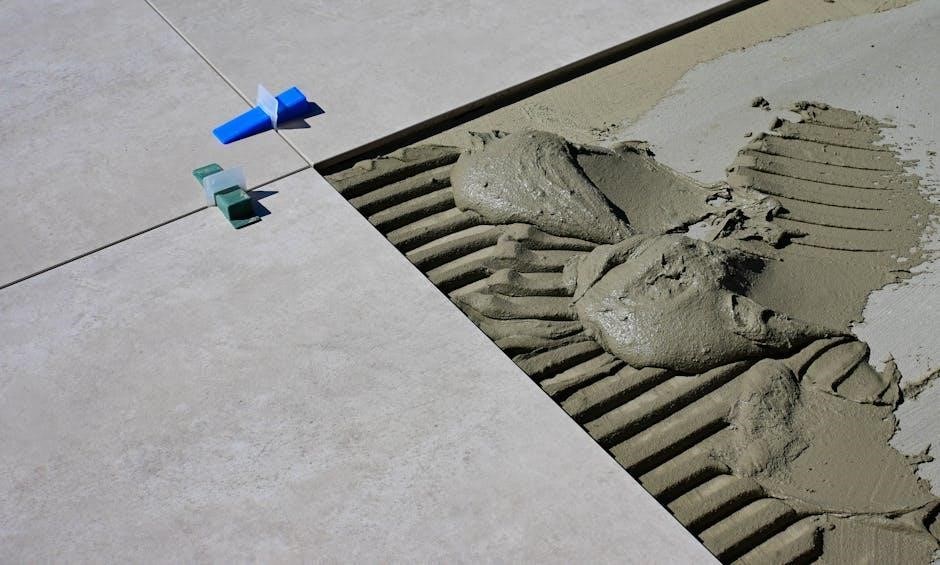
ANSI standards, accessible as detailed PDF guides, rigorously define proper mortar application techniques. Correct mortar coverage is vital for strong adhesion and preventing voids beneath tiles, a common cause of failures.
The ANSI documents specify appropriate trowel notch sizes based on tile size and type, ensuring optimal mortar distribution. Back-buttering larger tiles is often required, as detailed in the standards, to maximize contact with the substrate.
ANSI guidelines emphasize consistent pressure during tile placement to fully embed the tile into the mortar bed. Avoiding sliding movements prevents disrupting the mortar bond. Proper open time, dictated by mortar type and environmental conditions, is also crucial for successful setting.
Following these standards guarantees a durable installation.
Cutting Tile for Fit
ANSI standards, readily available as PDF documents, don’t dictate how to cut tile, but emphasize the importance of clean, precise cuts for a professional finish and to maintain structural integrity. Proper cutting minimizes chipping and ensures accurate fitting around obstacles.
Wet saws are generally preferred for most tile types, offering cleaner cuts and reducing dust. Snap cutters are suitable for softer tiles and straight cuts, but require careful scoring. Diamond blades, specified by ANSI A137.1, are essential for hard materials.
The standards indirectly address cutting by requiring accurate layout and dry-fitting before setting, minimizing the need for extensive field cutting. Precise cuts contribute to consistent joint widths, as outlined in ANSI guidelines.
Skillful cutting is key to a quality installation.

Joint Dimensions and Spacing
ANSI standards, found in PDF format, detail minimum joint width requirements based on tile size and application, crucial for movement and preventing cracking.
Proper spacing, guided by these documents, impacts installation success and long-term performance.
Minimum Joint Width Requirements
ANSI standards, readily available as PDF documents, meticulously outline minimum joint width requirements, varying based on tile format, size, and the intended application environment. Larger format tiles generally necessitate wider joints to accommodate potential movement and prevent stress fractures.
These guidelines aren’t arbitrary; they’re rooted in understanding tile’s expansion and contraction rates due to temperature fluctuations and substrate shifts. Ignoring these recommendations can lead to costly failures, like lippage or cracked tiles.
The ANSI specifications detail specific widths for different scenarios – wall installations versus floor installations, interior versus exterior applications, and even the type of setting material used. Consulting the official PDF is paramount for ensuring a compliant and durable installation.
Impact of Joint Size on Installation
The size of tile joints, detailed within ANSI standards PDF documents, profoundly impacts installation success and long-term performance. Narrower joints offer a more uniform aesthetic but demand exceptionally flat substrates and precise tile alignment, increasing labor and material costs.

Wider joints, while visually less refined, provide greater tolerance for minor substrate imperfections and allow for more movement, reducing the risk of cracking. They also simplify grout application and minimize lippage.
ANSI guidelines emphasize that joint size directly correlates with the setting material’s ability to compensate for tile variations. Selecting the appropriate joint width, as outlined in the PDF, is crucial for a structurally sound and visually appealing tile installation.

Post-Installation Procedures
ANSI standards PDF documents detail crucial post-installation steps like grouting, cleaning, and sealing to protect your tile investment.
Proper execution ensures durability and maintains the aesthetic appeal of the finished tile surface.
Grouting and Cleaning
ANSI A118.6 and related ANSI standards PDFs meticulously outline proper grouting procedures, emphasizing the importance of selecting the correct grout type based on joint width and tile material.
Grout application must follow specific timing guidelines to ensure complete fill and adhesion, preventing future cracking or water penetration.
Following grout manufacturer’s instructions, as referenced within the ANSI documents, is paramount.
Cleaning procedures, detailed in these standards, are equally critical. Initial cleaning removes excess grout haze without damaging the tile or grout itself.
Acidic cleaners should be used cautiously, adhering to ANSI recommendations to avoid etching or discoloration. Thorough rinsing and drying complete the process, safeguarding the installation’s integrity and appearance.
Sealing Tile and Grout
ANSI standards PDFs don’t universally require sealing, but strongly recommend it for porous tiles like natural stone or unglazed ceramic, protecting against staining and water damage.
Grout, being particularly vulnerable, almost always benefits from sealing, as outlined in ANSI A118.8, minimizing discoloration and simplifying cleaning.
Selecting the appropriate sealer – penetrating or topical – depends on the tile and grout type, detailed within the referenced ANSI documentation.
Proper application is crucial; multiple thin coats are generally preferred over a single heavy coat, ensuring complete coverage and optimal performance.
Regular re-application, as per the sealer manufacturer’s guidelines and ANSI recommendations, maintains long-term protection and preserves the installation’s aesthetic appeal.

ANSI Standards Resources & PDFs
ANSI tile installation standards PDFs are available through the ANSI website and industry associations, offering detailed specifications for proper tile work.
Accessing these resources ensures compliance and quality installations.
Where to Find Official ANSI Documents
Locating official ANSI tile installation standards PDFs requires navigating a few key resources. The primary source is the ANSI Webstore (webstore.ansi.org), where you can purchase and download the latest versions of standards like A137.1 and A108 series.
However, these documents often come with a cost. The Tile Council of North America (TCNA) (www.tcnatile.com) provides access to some ANSI standards, often as part of their membership benefits or through specific publications.
Additionally, the International Code Council (ICC) (www.iccsafe.org) may offer access to relevant ANSI standards incorporated into building codes. Be cautious of unofficial sources, as outdated or inaccurate PDFs can lead to installation errors. Always verify the document’s revision date and source to ensure compliance.
Understanding ANSI A137.1 Specifications
ANSI A137.1 defines the specifications for ceramic tiles, crucial for selecting appropriate materials. This standard details tile properties like water absorption, size variation, and breaking strength, impacting installation success.
When reviewing ANSI A137.1 PDFs, pay close attention to the tile’s group classification (I, II, III, IV, V) indicating its suitability for different traffic levels and applications.
Understanding these classifications ensures you choose tiles capable of withstanding intended use. The standard also covers chemical resistance and shade variation, influencing grout selection and overall aesthetic consistency. Proper interpretation of A137.1 is vital for a durable and visually appealing tile installation, preventing future failures.